
 EN
EN
Understanding the fundamental differences between partially threaded and fully threaded bolts is essential for engineers, contractors, and procurement professionals making critical fastener decisions. These two distinct bolt configurations serve different mechanical purposes and are designed for specific application requirements in construction, manufacturing, and industrial assembly processes.
The distinction between partially threaded and fully threaded bolts affects load distribution, installation methods, joint behavior, and overall structural performance. While both fastener types share similar head configurations and material properties, their threading patterns create significantly different mechanical characteristics that influence their suitability for various engineering applications and assembly scenarios.
Threading Pattern Characteristics
Partial Threading Configuration
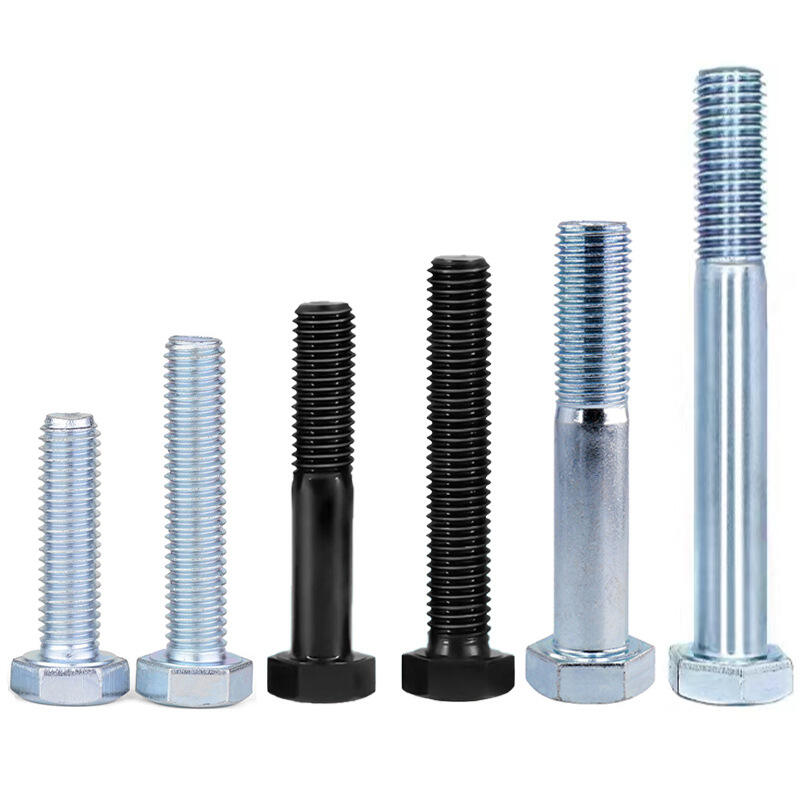
Partially threaded bolts feature threads that extend only partway along the bolt shank, typically covering approximately one-third to two-thirds of the total bolt length. The threaded portion begins at the bolt tip and extends toward the head, leaving a smooth, unthreaded section immediately below the bolt head. This smooth shank section maintains the bolt's full nominal diameter without thread root reductions.
The unthreaded portion of partially threaded and fully threaded bolts provides several mechanical advantages in specific applications. The smooth shank acts as a precise dowel pin, enabling accurate positioning between assembled components while maintaining consistent hole alignment. This configuration prevents thread engagement in the bolt shank area, reducing wear and galling during assembly operations.
Manufacturing standards typically specify thread lengths for partially threaded bolts based on bolt diameter and intended application. Standard thread lengths range from 1.5 times the bolt diameter for shorter bolts to 2.5 times the diameter for longer fasteners. This standardization ensures consistent performance across different manufacturers and applications while maintaining interchangeability in common fastener sizes.
Full Threading Configuration
Fully threaded bolts contain continuous threads running from the bolt tip to just below the head, maximizing the threaded engagement length available for clamping applications. This configuration eliminates the smooth shank section entirely, providing thread engagement throughout the bolt's working length. The continuous threading pattern allows for greater flexibility in positioning nuts and washers along the bolt length.
The extended thread engagement of fully threaded bolts increases the available clamping length, making these fasteners particularly suitable for applications requiring adjustment capabilities or variable assembly thicknesses. The continuous threading also provides multiple engagement points for nuts, enabling the creation of adjustable joints or the accommodation of varying material thicknesses without requiring different bolt lengths.
Thread quality remains consistent throughout the length of fully threaded bolts, with manufacturers maintaining precise thread pitch and profile characteristics across the entire threaded surface. This consistency ensures reliable thread engagement and prevents binding or cross-threading during installation, particularly important in automated assembly processes where consistent threading performance is critical.
Mechanical Performance Differences
Load Distribution Patterns
The load distribution characteristics of partially threaded and fully threaded bolts differ significantly due to their distinct threading configurations. Partially threaded bolts concentrate tensile loads in the smooth shank section, which maintains the bolt's full cross-sectional area without thread root stress concentrations. This load distribution pattern typically results in higher tensile strength performance compared to fully threaded equivalents of the same material and diameter.
The smooth shank section of partially threaded bolts creates a more uniform stress distribution across the bolt's critical section, reducing stress concentration factors that can lead to fatigue failure in dynamic loading conditions. This characteristic makes partially threaded bolts particularly suitable for structural applications where high tensile loads and fatigue resistance are primary concerns, such as bridge construction and heavy machinery assembly.
Fully threaded bolts distribute loads across the threaded sections, with stress concentrations occurring at thread roots throughout the bolt length. While this distribution pattern may reduce the bolt's ultimate tensile strength compared to partially threaded alternatives, it provides more distributed load transfer into the connected materials, which can be advantageous in certain joint configurations where load spreading is beneficial.
Fatigue Resistance Characteristics
Fatigue performance represents a critical difference between partially threaded and fully threaded bolts, particularly in applications subject to cyclic loading conditions. The smooth shank section of partially threaded bolts eliminates thread root stress concentrations in the primary load-bearing area, significantly improving fatigue life under alternating stress conditions. This advantage becomes more pronounced as the number of load cycles increases.
Thread roots in fully threaded bolts create stress concentration points that can initiate fatigue cracks under repeated loading conditions. The continuous threading pattern means these stress concentrations exist throughout the bolt's working length, potentially reducing fatigue life compared to partially threaded alternatives. However, proper thread rolling processes can work-harden the thread surfaces, partially offsetting this disadvantage in some applications.
Engineering analysis of fatigue-critical applications must consider the specific loading patterns, stress amplitudes, and expected service life when selecting between partially threaded and fully threaded bolts. Dynamic applications such as vibrating machinery, seismic-resistant structures, and transportation equipment often benefit from the superior fatigue characteristics of partially threaded fasteners.
Application-Specific Selection Criteria
Structural Assembly Applications
Structural engineering applications frequently favor partially threaded bolts due to their superior load-carrying capacity and precise positioning characteristics. Steel frame construction, bridge assembly, and heavy equipment mounting typically specify partially threaded bolts where high tensile loads and accurate component alignment are essential. The smooth shank provides bearing support while eliminating thread interference in bolt holes.
The positioning accuracy provided by partially threaded bolts makes them ideal for applications requiring precise hole alignment between multiple components. Construction projects involving predrilled steel members, architectural metalwork, and precision machinery assembly benefit from the dowel effect created by the smooth shank section, which maintains dimensional accuracy during and after assembly.
Partially threaded and fully threaded bolts serve different roles in structural connections, with partially threaded variants typically used in tension-critical applications and fully threaded bolts employed where adjustability and variable engagement lengths are more important than maximum load capacity. Understanding these distinctions helps engineers select appropriate fasteners for specific structural requirements.
Adjustment and Maintenance Applications
Fully threaded bolts excel in applications requiring frequent adjustment, disassembly, or variable positioning capabilities. Equipment maintenance, adjustable mounting systems, and prototype assembly often benefit from the flexibility provided by continuous threading. The ability to position nuts anywhere along the bolt length enables fine-tuning of component spacing and accommodates tolerance variations in assembled parts.
Laboratory equipment, test fixtures, and adjustable machinery components frequently utilize fully threaded bolts where operational requirements may change over time. The continuous threading allows for easy repositioning of components without requiring different bolt lengths or specialized hardware. This flexibility reduces inventory requirements and simplifies maintenance procedures in complex mechanical systems.
Manufacturing processes involving frequent setup changes or product variations often specify fully threaded bolts for their adaptability. The ability to quickly adjust component positions or accommodate different part thicknesses without changing fastener lengths improves operational efficiency and reduces downtime in production environments where flexibility is valued over maximum strength performance.
Installation and Assembly Considerations
Installation Procedures and Techniques
Installation procedures for partially threaded and fully threaded bolts require different approaches to achieve optimal joint performance. Partially threaded bolts must be positioned so the smooth shank aligns with the bolt holes in the connected materials, ensuring proper bearing contact and preventing thread engagement in the hole walls. This positioning requirement demands careful measurement and planning during assembly operations.
The smooth shank of partially threaded bolts requires precise hole preparation to achieve proper fit and bearing contact. Hole diameter tolerances become more critical since the smooth shank must provide bearing support while maintaining appropriate clearance for assembly. Oversized holes can reduce the bolt's bearing capacity and compromise joint integrity, making accurate hole preparation essential for optimal performance.
Fully threaded bolts offer more installation flexibility since thread engagement can occur anywhere along the bolt length. This characteristic simplifies assembly procedures when dealing with variable material thicknesses or when exact bolt positioning is less critical. However, installers must ensure adequate thread engagement length to develop the required clamping force without overloading the threaded sections.
Torque Application and Preload Development
Torque application methods differ between partially threaded and fully threaded bolts due to their distinct load distribution characteristics. Partially threaded bolts typically require higher installation torques to achieve equivalent preload levels since the smooth shank section must stretch to develop clamping force. The absence of thread deformation in the smooth section can affect the relationship between applied torque and achieved preload.
Thread pitch and lead angle variations between partially threaded and fully threaded bolts can influence the mechanical advantage during tightening operations. Fully threaded bolts may achieve target preload levels with lower applied torques due to the continuous thread engagement, but installers must account for potential thread deformation and galling in longer threaded sections during high-torque applications.
Preload consistency becomes particularly important when mixing partially threaded and fully threaded bolts in the same assembly. Different torque-tension relationships require adjusted installation procedures to ensure uniform clamping forces across all fasteners. Quality control procedures must account for these differences to maintain consistent joint performance throughout the assembly.
FAQ
What are the main strength differences between partially threaded and fully threaded bolts?
Partially threaded bolts typically offer higher tensile strength because their smooth shank maintains the full nominal diameter without thread root stress concentrations. The unthreaded section carries tensile loads more efficiently, while fully threaded bolts experience stress concentrations at thread roots throughout their length. However, fully threaded bolts may provide better load distribution into connected materials due to their extended thread engagement length.
When should I choose partially threaded bolts over fully threaded bolts?
Choose partially threaded bolts for structural applications requiring high tensile strength, precise component positioning, and superior fatigue resistance. These bolts work best in permanent assemblies where the smooth shank provides bearing support and dowel action. Applications include steel construction, bridge assembly, and heavy machinery where maximum load capacity and positioning accuracy are critical requirements.
Can partially threaded and fully threaded bolts be used interchangeably in the same application?
Partially threaded and fully threaded bolts are generally not interchangeable due to their different mechanical characteristics and installation requirements. The smooth shank of partially threaded bolts provides specific bearing and positioning functions that fully threaded bolts cannot replicate. Additionally, their different torque-tension relationships and load distribution patterns require separate design considerations and installation procedures.
How do I determine the correct thread length for partially threaded bolts?
Thread length for partially threaded bolts should provide adequate engagement with the nut while ensuring the smooth shank aligns with the connected materials. Standard practice requires minimum thread engagement of one bolt diameter plus two thread pitches beyond the nut face. The thread length must also accommodate any washers or spacing requirements while maintaining the smooth shank position in the bolt holes of the assembled components.
Table of Contents
- Threading Pattern Characteristics
- Mechanical Performance Differences
- Application-Specific Selection Criteria
- Installation and Assembly Considerations
-
FAQ
- What are the main strength differences between partially threaded and fully threaded bolts?
- When should I choose partially threaded bolts over fully threaded bolts?
- Can partially threaded and fully threaded bolts be used interchangeably in the same application?
- How do I determine the correct thread length for partially threaded bolts?